
Reliable evening buses and regional railways are basic infrastructure for a fair transition.
Politicians regularly describe public transport as an environmental priority, but too often treat the service itself as an optional expense. Routes are cut, evening departures disappear and passengers are then blamed when ridership falls.
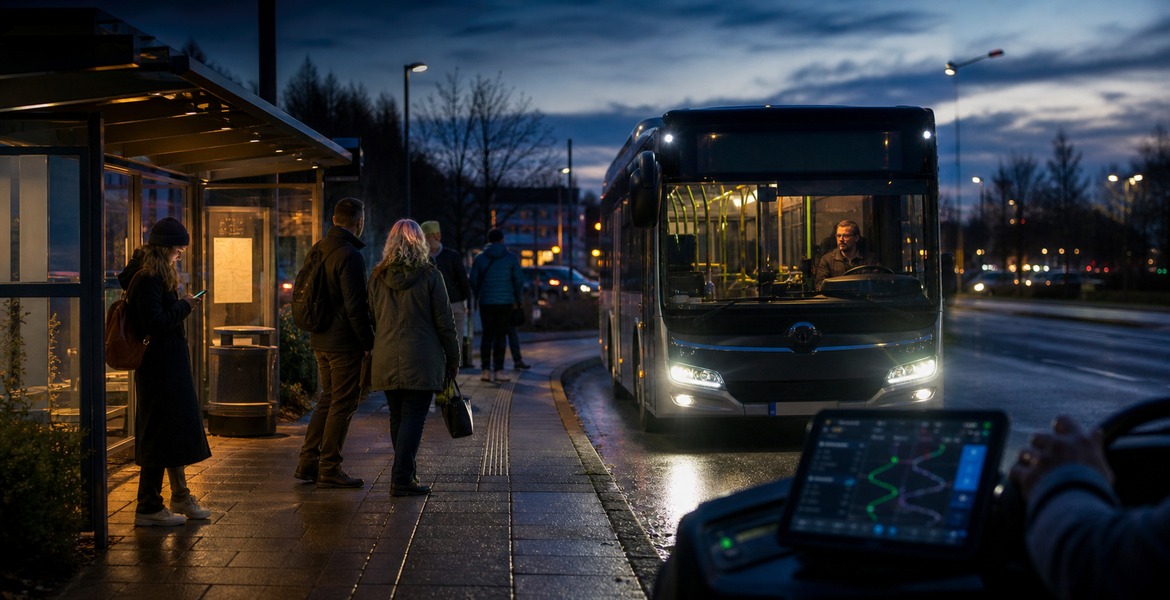
A credible climate policy starts with a timetable people can trust. Workers on late shifts, students and older residents need dependable connections every day, not only during peak commuting hours.
Investment should therefore be measured against access as well as ticket revenue. A lightly used rural departure may still prevent isolation, support local employment and reduce the need for a second family car.

The case for change
Public transport is not a decorative addition to climate policy. It is one of the practical systems that makes lower-emission daily life possible.
Stable funding would allow operators to plan routes over several years and coordinate timetables with schools, hospitals and major employers. Short annual contracts make that kind of network planning difficult.
A fair transition depends on services that people can use before they are asked to change established habits.
Transport policy also shapes access to work, education and healthcare. When evening routes disappear, the cost is carried most heavily by people with irregular hours, young residents and households that cannot maintain a second car.
What should happen next
Investment decisions should therefore measure access and resilience alongside passenger revenue. A bus that connects a village to essential services creates public value even when every departure is not full.
The reporting behind “Public transport is climate policy, not a luxury service” also points to a broader question for Debate: how a promising local initiative can become dependable enough to survive beyond its first season. Organisers are documenting costs, staffing needs and practical obstacles so that later decisions can be based on evidence rather than enthusiasm alone.
People involved in the work say the next stage will be deliberately measured. Instead of announcing a rapid expansion, the partners will compare participation, quality and day-to-day reliability over several months. That should make it easier to identify which parts deserve further investment and which need to be redesigned.
Access is another part of the evaluation. The project will be judged not only by headline numbers, but by whether people of different ages, incomes and levels of experience can use it without unnecessary barriers. Clear information, predictable opening times and affordable participation are all included in the review.
Independent researchers and community representatives have been invited to challenge the early findings. Their role is to test optimistic assumptions, speak with people who chose not to participate and examine any unintended effects that may be hidden by an encouraging launch period.
Funding for the immediate follow-up has been secured, although longer-term decisions remain open. A public progress report is expected after the next full operating cycle, with the underlying measurements published alongside the conclusions wherever privacy and commercial agreements allow.
For residents, the value of the experiment may ultimately be quite practical. If the approach works, it offers a model that other neighbourhoods can adapt without copying every detail. If it falls short, the transparent evaluation should still provide useful lessons about what a stronger version would require.