
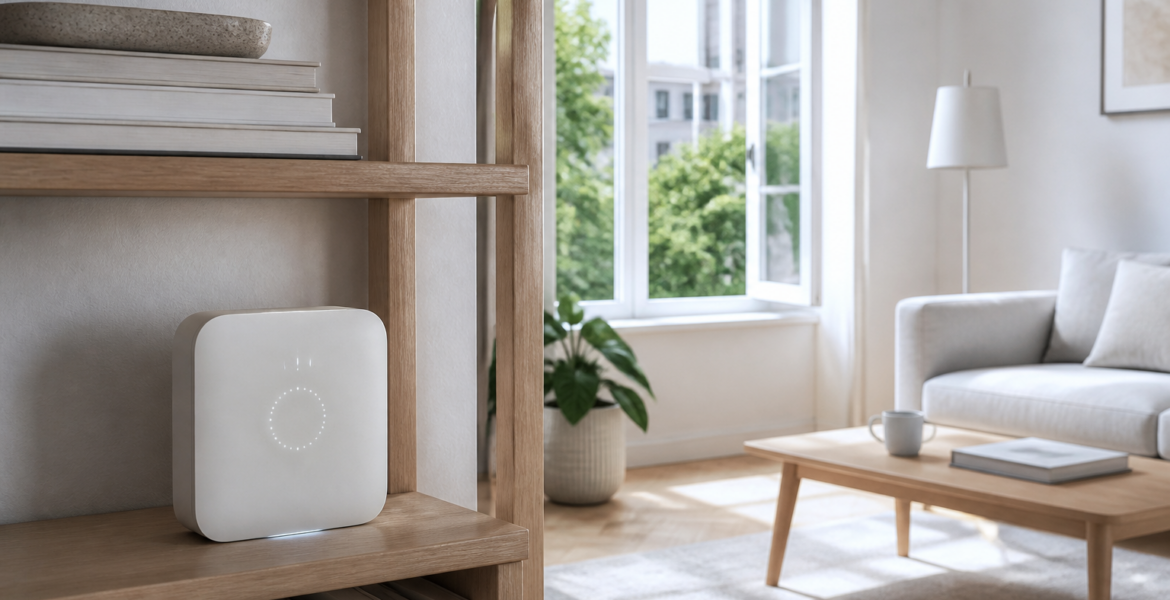
A discreet monitor translates invisible changes in the home into calm, useful guidance.
Indoor air is easy to ignore precisely because most changes cannot be seen. Vireo Home was created to make those changes understandable without turning the living room into a control centre. Its compact monitor tracks carbon dioxide, humidity, particles and temperature, then turns the readings into simple suggestions.
The system focuses on patterns rather than alarms. It may notice that a bedroom needs ventilation before sleep, that cooking raises particles for longer than expected or that dry winter air is affecting comfort. Advice is shown in plain language and can be dismissed when it is not useful.
Privacy was treated as a design requirement. Core measurements remain available locally, and households choose whether to enable remote access. Vireo says it does not sell behavioural data or use home activity for advertising profiles.
A measured approach
The monitor is designed to disappear into a shelf, with a low-energy display that brightens only when approached. A companion view gives longer trends for people who want detail without demanding daily attention.
For families managing allergies or working from home, that balance can be valuable. The goal is not to produce perfect air at every moment, but to make ventilation, heating and cleaning decisions with better information.
Vireo Home is available in two finishes and supports shared access for households, carers and small workplaces.
The reporting behind “How Vireo Home turns indoor air quality into practical daily choices” also points to a broader question for Health & Wellness: how a promising local initiative can become dependable enough to survive beyond its first season. Organisers are documenting costs, staffing needs and practical obstacles so that later decisions can be based on evidence rather than enthusiasm alone.
Evidence over time
People involved in the work say the next stage will be deliberately measured. Instead of announcing a rapid expansion, the partners will compare participation, quality and day-to-day reliability over several months. That should make it easier to identify which parts deserve further investment and which need to be redesigned.
Access is another part of the evaluation. The project will be judged not only by headline numbers, but by whether people of different ages, incomes and levels of experience can use it without unnecessary barriers. Clear information, predictable opening times and affordable participation are all included in the review.
Independent researchers and community representatives have been invited to challenge the early findings. Their role is to test optimistic assumptions, speak with people who chose not to participate and examine any unintended effects that may be hidden by an encouraging launch period.
Funding for the immediate follow-up has been secured, although longer-term decisions remain open. A public progress report is expected after the next full operating cycle, with the underlying measurements published alongside the conclusions wherever privacy and commercial agreements allow.
For residents, the value of the experiment may ultimately be quite practical. If the approach works, it offers a model that other neighbourhoods can adapt without copying every detail. If it falls short, the transparent evaluation should still provide useful lessons about what a stronger version would require.