
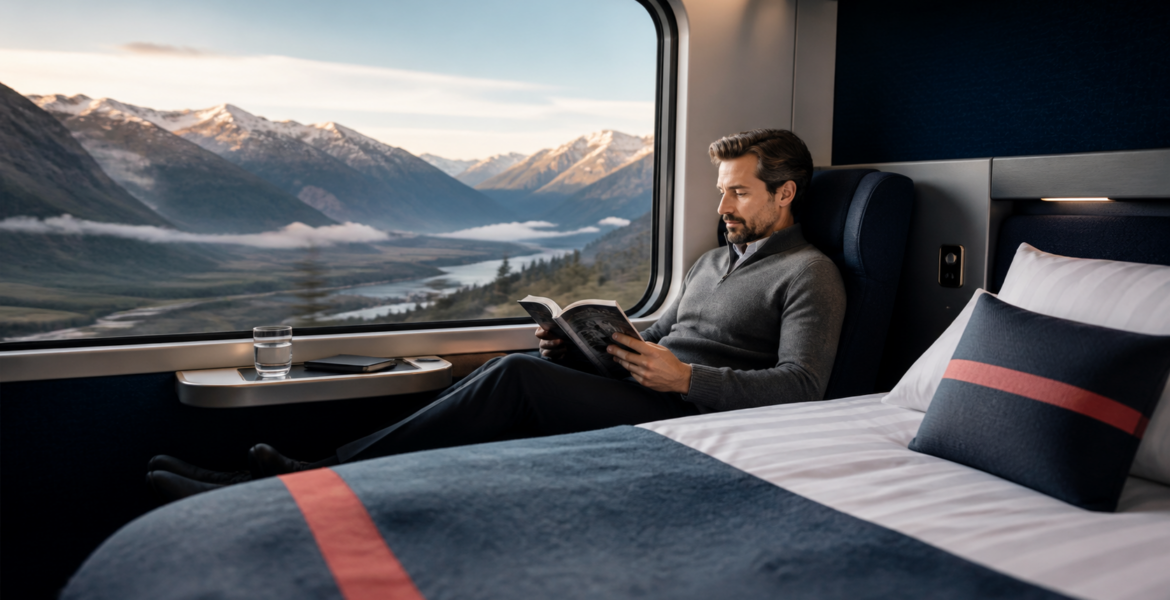
A new generation of quiet electric sleeper trains makes the journey part of the destination.
Crossing a continent overnight once meant choosing between romance and reliability. Northline Rail believes travellers should no longer have to make that choice. Its new electric sleeper service links three European routes with private rooms, calm shared lounges and timetables designed around a full night’s rest.
The trains have been developed around small details that become important after dark. Lighting changes gradually, corridor doors close softly and every berth has individual temperature and ventilation controls. Travellers can choose compact rooms for solo journeys or connecting cabins for families.
Dinner is served without forcing the evening into a fixed schedule. Seasonal dishes can be booked in the dining car or delivered to a cabin, while breakfast arrives shortly before the destination. A quiet lounge remains open for passengers who want to read or work.
The journey as part of the experience
Northline’s routes are built around useful city-centre connections rather than novelty excursions. Evening departures allow a full working day before travel; morning arrivals remove the airport transfer from the other end of the journey.
The company is also publishing energy and occupancy figures for each route. That transparency is intended to help business travellers compare the practical climate impact of overnight rail with short-haul flying.
For many passengers, however, the strongest argument may be less technical. Close the door in one city, watch the landscape settle into evening, and wake up somewhere new.
The reporting behind “Northline Rail brings comfortable overnight travel back to three European routes” also points to a broader question for Travel: how a promising local initiative can become dependable enough to survive beyond its first season. Organisers are documenting costs, staffing needs and practical obstacles so that later decisions can be based on evidence rather than enthusiasm alone.
A measured return to the rails
People involved in the work say the next stage will be deliberately measured. Instead of announcing a rapid expansion, the partners will compare participation, quality and day-to-day reliability over several months. That should make it easier to identify which parts deserve further investment and which need to be redesigned.
Access is another part of the evaluation. The project will be judged not only by headline numbers, but by whether people of different ages, incomes and levels of experience can use it without unnecessary barriers. Clear information, predictable opening times and affordable participation are all included in the review.
Independent researchers and community representatives have been invited to challenge the early findings. Their role is to test optimistic assumptions, speak with people who chose not to participate and examine any unintended effects that may be hidden by an encouraging launch period.
Funding for the immediate follow-up has been secured, although longer-term decisions remain open. A public progress report is expected after the next full operating cycle, with the underlying measurements published alongside the conclusions wherever privacy and commercial agreements allow.
For residents, the value of the experiment may ultimately be quite practical. If the approach works, it offers a model that other neighbourhoods can adapt without copying every detail. If it falls short, the transparent evaluation should still provide useful lessons about what a stronger version would require.