

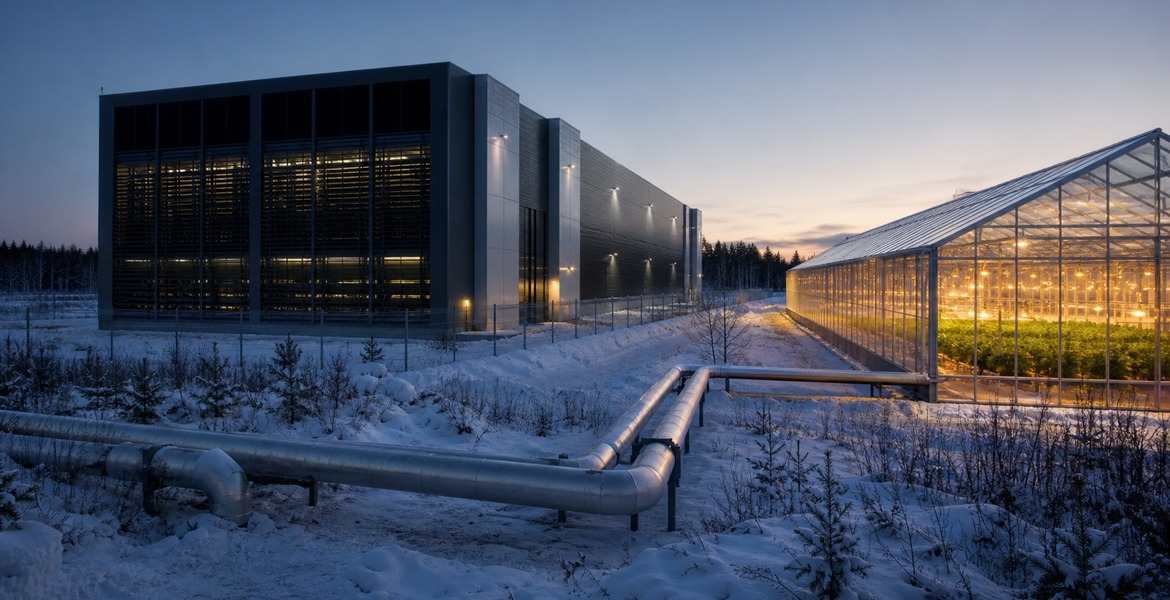
A fictional northern data centre is reusing excess heat for commercial greenhouses.
A fictional data centre is routing excess heat to a nearby greenhouse district under a new local energy agreement.
The project uses heat exchangers and a short district pipe to warm growing halls through the colder months.
Operators say the agreement improves the economics of both the data centre and the greenhouse site.

How the system works
Energy analysts caution that reuse projects depend heavily on distance, temperature and long-term demand.
Heat from the servers is transferred through a closed water loop to commercial greenhouses planned beside the facility. Operators expect the arrangement to replace much of the fossil heating normally used during cold months.
The contract includes public reporting of delivered heat, electricity use and outages so the claimed efficiency can be assessed over a full year.
The greenhouse operator will pay for usable heat rather than accepting it as a free by-product. Supporters say the contract gives both sides an incentive to maintain the connection and makes the economics easier to compare with conventional heating.
The test ahead
Local planners are considering a second connection to nearby public buildings. That expansion will proceed only after the first winter demonstrates stable temperatures and realistic maintenance costs.
The reporting behind “Northern data centre reuses excess heat for greenhouse district” also points to a broader question for Technology: how a promising local initiative can become dependable enough to survive beyond its first season. Organisers are documenting costs, staffing needs and practical obstacles so that later decisions can be based on evidence rather than enthusiasm alone.
People involved in the work say the next stage will be deliberately measured. Instead of announcing a rapid expansion, the partners will compare participation, quality and day-to-day reliability over several months. That should make it easier to identify which parts deserve further investment and which need to be redesigned.
Access is another part of the evaluation. The project will be judged not only by headline numbers, but by whether people of different ages, incomes and levels of experience can use it without unnecessary barriers. Clear information, predictable opening times and affordable participation are all included in the review.
Independent researchers and community representatives have been invited to challenge the early findings. Their role is to test optimistic assumptions, speak with people who chose not to participate and examine any unintended effects that may be hidden by an encouraging launch period.
Funding for the immediate follow-up has been secured, although longer-term decisions remain open. A public progress report is expected after the next full operating cycle, with the underlying measurements published alongside the conclusions wherever privacy and commercial agreements allow.
For residents, the value of the experiment may ultimately be quite practical. If the approach works, it offers a model that other neighbourhoods can adapt without copying every detail. If it falls short, the transparent evaluation should still provide useful lessons about what a stronger version would require.
The editorial team will return to the story as the evidence develops. That follow-up matters because early success can look different once routines, budgets and public expectations settle into place. Readers with direct experience of the initiative are being invited to share observations that can be checked and included in later reporting.